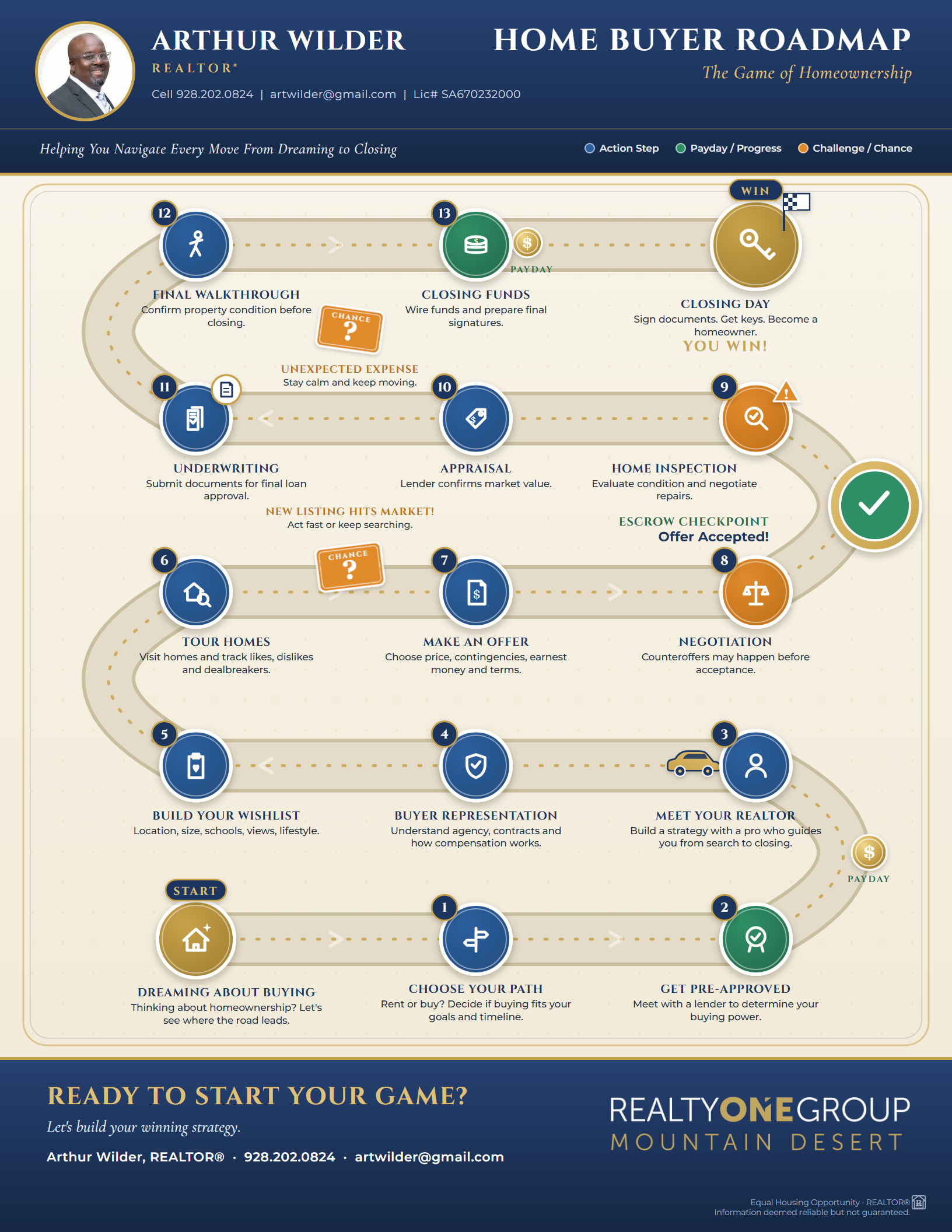
Thirteen squares stand between dreaming about a home in the high country and holding the keys to one. This is my buyer's road map: every step, in order, in plain English, with the Arizona details that actually matter.
Every purchase I have ever closed follows the same board: 13 squares from "should I even buy?" to closing day. Some squares are action steps you control. Some are payday squares where the work pays off. And a couple are chance squares, where the market deals you a card and we respond.
I have walked this board 96 times, start to finish, as the agent responsible for getting a buyer or seller across it. That is the whole value of the map: nothing on it will surprise me, so very little of it should surprise you. When you know what square comes next, a 40-page inspection report or a low appraisal stops being a crisis and becomes a move.
Read the steps below, download the print version to stick on the fridge, and when you are ready to roll the dice, start at square two: pre-approval.
The same order as the board. Skip a square and the game usually sends you back to it later, at a worse price.
Rent or buy? We decide whether buying fits your goals and timeline: how long you plan to stay, what rent costs you now, and what the same money does as a mortgage. If renting is still the smarter play this year, I will tell you so.
Meet with a lender and learn your real buying power before you fall for a house. Arizona offers customarily go out with a pre-qualification form attached, so sellers here expect it. This is the first payday square: pre-approved buyers shop with confidence and negotiate from strength.
The buyer consultation: we sit down, build a strategy, and map the search before we unlock a single door. You get a guide who works the whole board with you, from search to closing, and I learn exactly what winning looks like for you.
Since the industry rules changed in 2024, buyers sign a written buyer-broker agreement before touring homes. It spells out agency, what I do for you, and how my compensation works: in writing, and negotiable. I walk you through every line before you sign anything.
Location, size, schools, views, lifestyle. Up here I add a few high-country columns: garage for snow, natural gas versus propane, HOA and rental rules, and what your drive looks like in a storm. Needs on one list, wants on another; it keeps us honest later.
We visit homes and track likes, dislikes and dealbreakers as we go. This is where the board deals its chance card: a new listing hits the market, and you act fast or keep searching. Good notes plus day-one listing alerts let you move quickly without settling.
Found the one? We choose price, contingencies, earnest money and terms, and write it on the Arizona purchase contract. Your earnest money is deposited with the title company, not handed to the seller, and the contract's contingencies protect it. I price the offer off real closed sales, not a portal estimate.
Counteroffers may happen before acceptance; most deals take a round or two. We trade price, timing and terms deliberately instead of emotionally. When both sides sign, you hit the escrow checkpoint the board celebrates: offer accepted.
During your inspection period, typically 10 days here, we evaluate the home's condition and negotiate repairs. Arizona uses the BINSR, the Buyer's Inspection Notice and Seller's Response: the form where we ask for corrections, take a credit, accept as-is, or walk with your earnest money.
Your lender orders an appraisal to confirm the price is supported by market value. Comes in at or above your price: onward. Comes in short: we renegotiate, challenge it with better comps, or bridge the gap. Pricing the offer right at square seven is what makes this square boring.
You submit documents and the lender's underwriter gives the file its final review before loan approval. House rule for this square: no new credit cards, no financed furniture, no truck, no job changes until you have keys. Quiet finances keep the file moving.
Shortly before closing we walk the property one last time to confirm its condition: agreed repairs done, systems running, nothing removed that should have stayed. It is a 30-minute square that protects everything you have played for.
You wire your funds to the title company and prepare for final signatures. One hard rule: confirm wire instructions by phone, on a number you already trust, never from an email. Wire fraud is real, and this is the square where it hunts.
Sign documents. Get keys. Become a homeowner. In Arizona you sign at the title company and the deal is done when the county records the deed, usually within a day. I will be there when the keys hit your hand.
This is the same road map I hand buyers at our first meeting: all 13 squares from start to win. Save it, print it, stick it on the fridge, and check squares off as we land on them.
Five squares trip people up over and over. Every one of them is avoidable, and none of them is fatal.
Square two is the move that unlocks the rest of the board. Get pre-approved, then let's build your winning strategy: 13 squares, one guide, straight answers the whole way.